Meditations
A foundational record of reflective exercises written by a ruler confronting duty, mortality, and the temptation of power. Read it as a working ethical notebook, not a polished management manual. (Marcus Aurelius, 2002)

Wisdom traditions · OmniLeadership 360
Character under pressure. Responsibility beyond the self.
Stoicism offers a demanding ethical question: when circumstances are uncertain, what type of person will you choose to be? Illuminated are self-mastery and virtue, while reminding leaders that composure matters because this enables just, responsible action; it does not make people invulnerable.
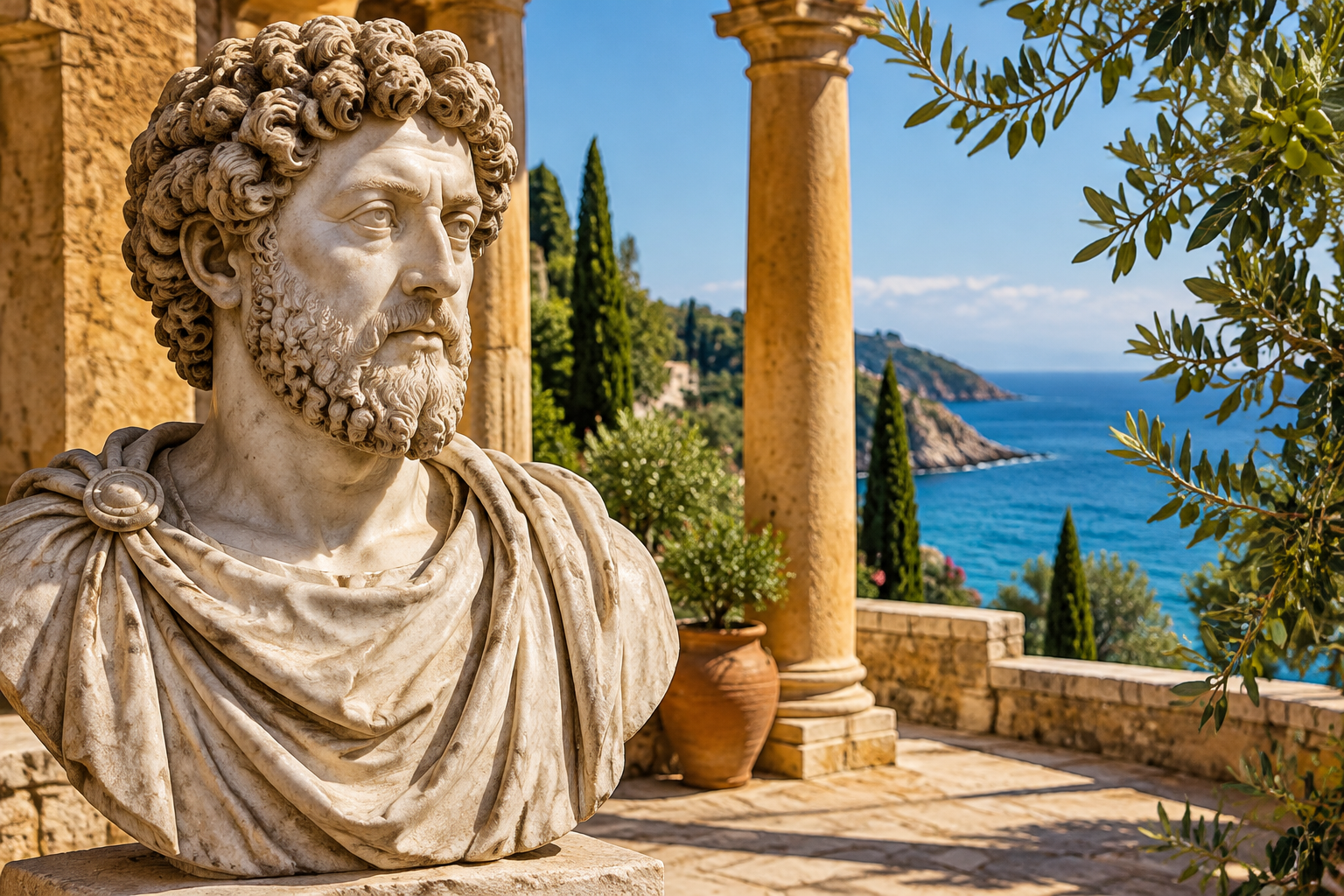
Historical and philosophical context
Founded in Athens by Zeno of Citium around 300 BCE and later developed by Roman thinkers, Stoicism joins reasoning, an understanding of nature, and ethics. Its practical orientation asks people to examine judgments, train desires, and fulfill responsibilities. Epictetus distinguishes what depends on our agency from what does not; this distinction directs effort toward choices without pretending that leaders control every outcome (Epictetus, 2008).
Stoic self-mastery is not the suppression of grief, the denial of structural injustice, or indifference toward other people. Marcus Aurelius repeatedly connects personal discipline with social responsibility (Marcus Aurelius, 2002). For contemporary leadership, the challenge is to preserve moral agency while acknowledging vulnerability, asking for help, and addressing conditions that cause avoidable harm.
Three disciplines for deliberate leadership.
Epictetus’s practical teaching is often organized around desire, action, and assent—the evaluation of impressions before accepting them as true. Sellars (2022) revisits this threefold structure, cautioning against treating its elements as disconnected exercises. Leaders need both disciplined interpretation and the readiness to act appropriately.
A difficult meeting makes the connection concrete. First distinguish the observable event from the story you have attached to it. Then identify the responsibility that remains yours: listening, checking evidence, setting a fair expectation, or correcting a mistake. Finally act without requiring universal approval. The purpose is ethical judgment, not a technique for winning every exchange.
Resilience must remain accountable to justice.
Seneca’s letters present moral development through everyday questions about time, friendship, wealth, adversity, and progress (Seneca, 2015). Their correspondence format makes philosophy a sustained conversation rather than a checklist of slogans. Wisdom, courage, justice, and moderation provide a vocabulary for evaluating both the goal and the means used to pursue it.
Sellars (2017) examines philosophy as a way of life: philosophical commitments can shape conduct and the whole person, rather than remain purely theoretical. His study of Shaftesbury also explores the reception of Stoic practical philosophy in a later intellectual setting (Sellars, 2016). These are interpretive philosophical studies, not clinical trials or evidence that a particular leadership program improves performance.
Contemporary leadership application
A department leader facing a missed deadline can separate uncontrollable events from decisions still available, acknowledge the team’s strain, clarify priorities, and allocate work fairly. In education, the same discipline supports a measured response to criticism; in business, it can support a principled refusal to distort results. Neither application excuses inadequate resources or replaces professional care.
A question for reflection
Does my composure help me act more justly, or merely make discomfort easier to ignore?
Three substantial nonfiction books
A foundational record of reflective exercises written by a ruler confronting duty, mortality, and the temptation of power. Read it as a working ethical notebook, not a polished management manual. (Marcus Aurelius, 2002)
A rigorous guide to agency, disciplined judgment, and freedom from unexamined desires. Its dialogues invite readers to test their assumptions rather than seek reassurance. (Epictetus, 2008)
A substantial collection connecting moral reasoning with ordinary life, friendship, and adversity. Seneca’s own political and financial position also invites critical reflection on the gap between ideals and conduct. (Seneca, 2015)
An integrative perspective
These sources provide philosophical, historical, and interpretive foundations. The leadership examples on this page are proposed applications, not evidence that the tradition or OmniLeadership 360 has been validated as a complete intervention. Ethical reflection, professional judgment, and context-specific evaluation remain essential.
Return to the wider leadership perspectiveAPA 7 · Sources cited on this page
Epictetus. (2008). Discourses and selected writings (R. Dobbin, Trans.). Penguin Books.
Marcus Aurelius. (2002). Meditations (G. Hays, Trans.). Modern Library.
Seneca. (2015). Letters on ethics: To Lucilius (M. Graver & A. A. Long, Trans.). University of Chicago Press.
Sellars, J. (2016). Shaftesbury, Stoicism, and philosophy as a way of life. Sophia, 55(3), 395–408. https://doi.org/10.1007/s11841-015-0483-z
Sellars, J. (2017). What is philosophy as a way of life? Parrhesia, 28, 40–56. https://www.parrhesiajournal.org/parrhesia28/parrhesia28_sellars.pdf
Sellars, J. (2022). Revisiting the three topoi in Dissertationes 3.2. Aitia. Regards sur la culture hellénistique au XXIe siècle, 12. https://doi.org/10.4000/aitia.10498